


Adventure Learning
From the Arctic to Africa, adventure learning (AL) is changing how students learn and teachers teach. AL provides students with authentic learning experiences within a hybrid online environment. Learners separated by distance and time are able to connect with one another, access authentic data and media assets tied to real-world events, and collaborate with each other and with field experts online.
Adventure learning (Doering, 2006; Doering & Miller, 2009) is a form of hybrid distance education that blends experiential (Dewey, 1938; Kolb, 1984) and inquiry-based (Bransford, Brown, & Cocking, 1999) pedagogies. It emphasizes the importance of real-world, authentic problem solving, and merges an online learning environment with teacher-led classroom activities, making use of both online and mobile technologies to share real-world issues with learners.
Within an AL program, a team undertakes an exploration centered on a specific location and topic; for example, climate change in the Arctic. The team travels out into the field to capture authentic data and narratives that are synched with a predesigned inquiry-based curriculum tied to that issue and location. The field experiences, data, media assets, and observations of the team are then shared online in an environment in which learners are able to actively participate and collaborate with the explorers, their peers around the world, their teacher(s), and a variety of field experts. These online collaboration and interaction opportunities allow learners to form connections between what is happening in the real world and their studies. Learners complete activities related to those real-world events, engage in online and face-to-face discussions around them, and present potential solutions to issues that are raised.
The best-known and researched AL programs to date, such as the GoNorth! Adventure Learning Series and Earthducation, have involved large-scale expeditions and remote locales. WeExplore seeks to change that by providing an online environment that structures and scaffolds educators and learners through the process of creating their own smaller-scale AL projects! WeExplore allows learners to act not only as explorers and expedition leaders within their own communities seeking out answers to their own questions, but also to serve as teachers and facilitators, strengthening their knowledge of a subject and a geographical area as they communicate to others about it. Learners engaged with WeExplore also have the opportunity to practice their social networking skills as they interact with others online around a topic that is important to them.
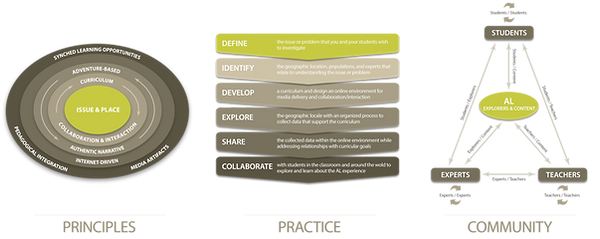
AL 2.0 Principles
The AL 2.0 Principles, created from 6 years of designing, developing, delivering, and researching AL environments, is an extension of the original AL model and identifies the following principles of a successful AL program designed by teachers and students: (a) the identification of an issue and respective location of exploration; (b) a researched curriculum grounded in problem-solving that guides the progression and evolution of the AL program; (c) collaboration and interaction opportunities between students, experts, peers, explorers, and content; (d) education that is adventure-based; (e) exploration of the issue, environment, local population, culture, and additional relevant factors that provide an authentic narrative for students and teachers to follow; (f) design and utilization of an Internet-driven learning environment for curricular organization, collaboration, and media delivery; (g) enhancement of the curriculum with media (e.g., photos, video, audio, etc.) and text delivered from the field in a timely manner; (h) synched learning opportunities with the AL curriculum and online learning environment; and (i) pedagogical integration guidelines and strategies for the curriculum and online learning environment.
AL Practice
One of the caveats of the original AL model was the belief that AL represents an elitist model of online education made possible only through sizeable funding and considerable development timelines. Although this may be the case in large-scale AL projects such as GoNorth!, successful and engaging AL programs can take place in one’s own local community over the span of a few hours, days, or weeks, and can even take place in one’s own backyard. Therefore, by rearticulating the original AL model into a practical model of integration, we encourage teachers and students to embark on their own unique AL experiences.
AL Community
The AL 2.0 Community model outlines the various connections and social affordances that are instrumental in determining if and how social collaboration and interaction within an AL project take place. If the synthesis of issue, place, and curriculum serves as the heart of an AL program, then collaboration and interaction serve as the arteries and veins necessary for prolonged sustainability and vivacity.
AL cannot be successful at a transformational level unless there is successful interaction and collaboration at multiple levels between students and teachers; between students and subject-matter experts; between teachers and subject-matter experts; between students, teachers, subject-matter experts, and the AL adventurers and content; and between students themselves, teachers themselves, subject-matter experts themselves.